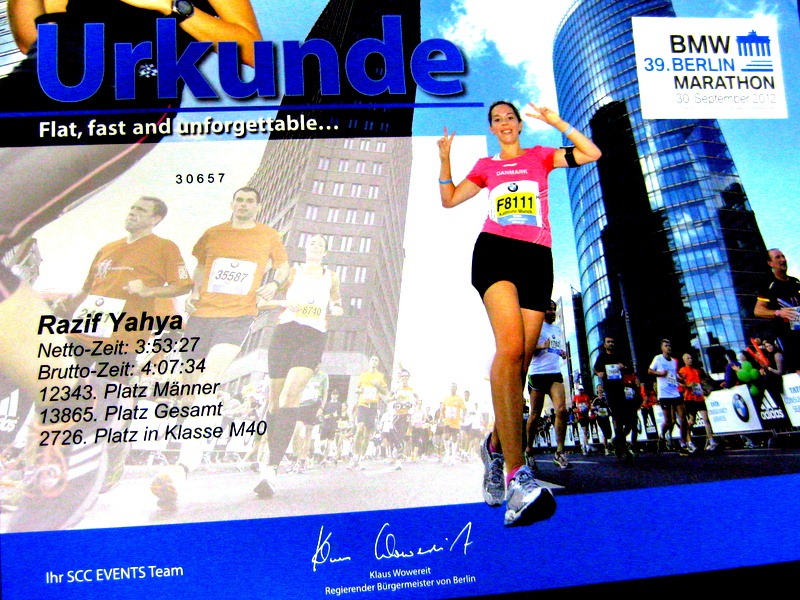
My Berlin Marathon’s Certificate finally arrived today.
Which reminds me that i haven’t blog about my experience running one of the biggest Marathon in the world.
Stay tune folks ……

My Berlin Marathon’s Certificate finally arrived today.
Which reminds me that i haven’t blog about my experience running one of the biggest Marathon in the world.
Stay tune folks ……

Each of our feet has 26 bones, 33 joints, and more than 100 tendons, muscles and ligaments.
Sometimes we do get injured, when that happened just sit back rest and recover.
Take care and keep running injury free peeps.
Taken from: Anatomy In Motion

Total Mileage for 2012 was at 3,518km inclusive of Running, Cycling & Swimming.
My Running Mileage is only 2,836 km and it was more than 2011 (2,375km).
2012 was a great year for me, and i managed to accomplished all that mileage injury free (most important part).
Here’s to a brand new year, i might even try to Run To The Moon and clocking 2,013 Miles between that.
This article taken from Running Competitor.com .
Stress more on time on feet method “school of thought”, i hope this would be useful for you Ultra wannabe out there.
 Ultrarunning isn't about seeing how fast you can go, but how far you can go.
Introductory guide to ultrarunning and a beginner’s training plan to tackling a 50K.
Crossing the finishing line of a marathon is the completion of a journey well beyond the 26.2 miles of the race.
The successful completion of the marathon brings with it a heady mix of exhilaration, exhaustion and relief. Not to mention trashed hamstrings, quads and calves. Yet inevitably in the wake of the personal victory and after the pain has receded into a distorted memory it’s time to figure out what’s next.
For some, the next goal will be to go faster—to break a time goal or to qualify for Boston. For others the goal will just be to package the love for running with a love for traveling and do that next marathon in Dublin or on the Great Wall of China. For some, one is enough.
But for others, a special breed, the next challenge is about going farther. It’s time to take the journey into what is not just the next distance, but also the next world: ultrarunning. The 50K (roughly 31 miles) is the “shortest” standard distance you’ll find when you push beyond the limits of the marathon. This guide is aimed at training you to go the distance and, perhaps, give you a taste of, one day, going even farther and training for a 50- or 100-mile race.
Getting Started
We asked veteran ultrarunning coach Sean Meissner for the essential advice he would give to a runner wanting to take on the challenge of a first 50K. Meissner, who is based in Spokane, Wash., knows what he’s talking about. Not only does he have more than 100 ultra-distance race finishes to his name—including consecutive victories (2010 and 2011) at the Desert RATS 148-mile stage race between Fruita, Colo., and Moab, Utah—he has also been coaching beginning ultrarunners for more than a decade.
The following plan assumes you have a solid marathon or two (or more) under your belt and the critical experience and base-building that comes with it.
“I think a 16-week build-up would be about perfect for the marathoner looking to complete their first 50K,” Meissner says.
But he’s quick to point out there is no one-size-fits-all approach to a foray into ultrarunning. Adapting to increased mileage, developing the ability to run while fatigued and experimenting with different nutrition and hydration needs are all very individual endeavors. “Ask others for advice, but try things for yourself because everyone is so different in what works best for them,” he says.
Meissner generally believes long runs—which vary between 10 and 26 miles in this plan—should be spaced between six and 10 days apart. He also suggests seeking out hilly trails to bolster strength and refine trail running skills. Since most 50K races are trail races, he says it’s important to recalibrate your expectations of speed (you’re going to go slower than on the roads) and understand that the key goal of the long run is to develop your aerobic capacity and strength to handle the goal race distance.
To prepare his runners for the rigors of the final miles of the 50K, Meissner schedules a tempo-like run the day following the key long runs in the program.
“This will help simulate the fatigue you’ll be dealing with in the latter stages of the race.” Additionally, Meissner is a big believer in incorporating hill running and hill repeats into the overall program to build strength.
“I’m a big fan of hill work,” Meissner says. “For newer ultrarunners, I advocate adding hills into long runs and one other day each week on a shorter run. For a bit more experienced runners, one day every week or two of hill repeats are great, along with a hilly long run. The strength gained from running hills not only makes a runner stronger, but that strength then also turns into speed on the flats without the added pounding of actual speed work.”
Included in the schedule are opportunities to include races to sharpen strength.
“Tune-up races are great,” Meissner says. “They’re fun to run, great for checking to see where you’re at fitness-wise, and are a great chance to test your gear and nutrition for the upcoming ultra. When doing tune-up races, it’s best to keep the eye on the goal and not go too all out.” In other words, be on the cautious side with your pacing.
| WEEK | Monday | Tuesday | Wednesday | Thursday | Friday | Saturday | Sunday |
| 1 | OFF OR EASY SWIM | 45-60 minutes easy plus core routine | 45 minute hilly run | 1:15 to 1:30 easy plus core routine | Off or easy swim or jog | LONG RUN: 10 MILES | 1-hour medium effort run |
| 2 | OFF OR EASY SWIM | 45-60 minutes easy plus core routine | Hill repeats: 3 x 600m | 1:15 to 1:30 easy plus core routine | Off or easy swim or jog | 12 | 1-hour medium effort run |
| 3 | OFF OR EASY SWIM | 45-60 minutes easy plus core routine | 50 minute hilly run | 1:15 to 1:30 easy plus core routine | Off or easy swim or jog | 14 | 1-hour medium effort run |
| 4 | OFF OR EASY SWIM | 45-60 minutes easy plus core routine | hill repeats: 5 x 600 | 1:15 to 1:30 easy plus core routine | Off or easy swim or jog | 16 | 1-hour medium effort run |
| 5 | OFF OR EASY SWIM | 45-60 minutes easy plus core routine | 55 minute hilly run | 1:15 to 1:30 easy plus core routine | Off or easy swim or jog | 18 | 1-hour medium effort run |
| 6 | OFF OR EASY SWIM | 45-60 minutes easy plus core routine | Hill repeats: 7 x 600 | 1:15 to 1:30 easy plus core routine | Off or easy swim or jog | 20 | 1-hour medium effort run |
| 7 | OFF OR EASY SWIM | 45-60 minutes easy plus core routine | 60 minute hilly run | 1:15 to 1:30 easy plus core routine | Off or easy swim or jog | 16 | 1-hour medium effort run |
| 8 | OFF OR EASY SWIM | 45-60 minutes easy plus core routine | 8 x 600m hill repeats | 1:15 to 1:30 easy plus core routine | Off or easy swim or jog | 22 | 1-hour medium effort run |
| 9 | OFF OR EASY SWIM | 45-60 minutes easy plus core routine | 65-minute hilly run | 1:15 to 1:30 easy plus core routine | Off or easy swim or jog | 16 | 1-hour medium effort run |
| 10 | OFF OR EASY SWIM | 45-60 minutes easy plus core routine | 9 x 600m hill repeats | 1:15 to 1:30 easy plus core routine | Off or easy swim or jog | 24 | 1-hour medium effort run |
| 11 | OFF OR EASY SWIM | 45-60 minutes easy plus core routine | 70-minute hilly run | 1:15 to 1:30 easy plus core routine | Off or easy swim or jog | 16 | 1-hour medium effort run |
| 12 | OFF OR EASY SWIM | 45-60 minutes easy plus core routine | 10 x 600m hill repeats | 1:15 to 1:30 easy plus core routine | Off or easy swim or jog | 26 | 1-hour medium effort run |
| 13 | OFF OR EASY SWIM | 45-60 minutes easy plus core routine | 70-minute hilly run | 1:15 to 1:30 easy plus core routine | Off or easy swim or jog | Race: Controlled 10-mile or half-marathon race | 1-hour medium effort run |
| 14 | OFF OR EASY SWIM | 45-60 minutes easy plus core routine | 8 x 600m hill repeats | 1:15 to 1:30 easy plus core routine | Off or easy swim or jog | 10k-race controlled | |
| 15 | OFF OR EASY SWIM | 45-60 minutes easy plus core routine | 5 x 600m hill repeats | 1:15 to 1:30 easy plus core routine | Off or easy swim or jog | 5k race controlled | 90-minute run |
| 16 | OFF OR EASY SWIM | 45 minutes easy | 1-hour easy | OFF | OFF | 30 minutes easy | 50K RACE |
Sunny Blende, M.S., is a noted sports nutritionist within the ultrarunning world and a longtime ultra endurance athlete with a focus on the 50K to 50-mile trail races. Blende started her nutrition consulting company, Eat4Fitness, in 1998 and has since become one of the most sought-out pace runners in the ultra world. (Imagine having a sports nutritionist at your side while you’re battling your way through 130-degree heat at the 135-mile Badwater ultramarathon. Not a bad idea, huh?)
Blende characterized what ultrarunning is all about when she told “Born to Run” author Christopher McDougall, ultramarathons are “eating and drinking contests with a little exercise and scenery thrown in.”
“If you’re doing your first 50K,” Blende says. “You should expect to be out there at least five or six hours.”
Unlike the typical road marathon event where aid stations can be as often as every mile, an ultrarunner needs to be far more self-sufficient. There are fewer aid stations and they are far between while the needs of hydration, electrolyte and energy intake are heightened by the vast amount of time spent on the trail or road.
Her key piece of advice? “Start early and don’t get behind,” she says. “You can’t make it up later in the race. Let’s say you’re running 10-minute miles. That requires at least 600 calories per hour, while your body is likely only going to be able to absorb 240 calories per hour. So it’s a fuel-deficit sport.” Blende suggests during the first hour to 90 minutes to only take in water, but after it’s best to get on strict schedule tuned to what you learned in training. “I suggest setting your watch timer so that it beeps every 20 or 30 minutes.” When the watch beeps, it’s time to drink and eat per the race plan you’ve established through experimentation with your training.
A second important thing to learn, Blende says, is what she says elite runners have learned and mastered when it comes to mid-race nutrition.
“The elite runners don’t think of it as food when they’re racing. They think of it as fuel.” Blende’s point is if you want to be successful in the ultra world it’s time to forget about being picky with what you eat. “It’s all about just getting gas into the car.”
1. Find out what you can about the products offered on the course. Check the website or contact the 50K race to see what kind of gels, bars, drinks and foods will be available on the course and how often. While you may be able to haul along your own supplies during the race, having access to nutrition during the race will make things easier. Keep in mind, too, that many aid stations will have a variety of “real” food, including everything from buckets of fried chicken to pizza and cups of warm mashed potatoes.
2. Create a race nutrition training plan. “There are no scientific studies to rely on,” Blende says about ultra running. Most sports nutrition studies max out at 2 or 3 hours, and after that it’s hard to get scientists or subjects interested in being in the lab any longer. Hence, you need to become your own scientist. With an idea of what will be available at aid stations, use all of your long training runs as opportunities to conduct experiments on what and how much food and drink you can consume while running long. Make this a key part of your training log so you can dial in your race day nutrition.
3. Determine your sweat rate. “Without proper hydration nothing else works,” Blende says. “You want to know your sweat rate so you can adequately rehydrate while your running.” To determine your sweat rate, weigh yourself naked before a 1-hour run. Run the run without taking in any food or drink. At the end of the run, pee if you need to, then re-weigh yourself. For every two pounds of weight you’ve lost, you’ve lost one liter of water. So if you lost four pounds in the hour, your sweat rate is two liters per hour—this would be your target intake of liquids.
4. Use your long runs to test how many calories you can consume. With your sweat rate in hand, start testing your hydration and nutrition plan with your very first run. Again, use your watch timer to keep you on track. Blende recommends starting by trying to consume 200 calories of energy per hour. If you’re using gels, for example, check the package for caloric content. Many gels provide around 100 calories, so plan on taking two gel packets per hour on your first long run. If you can tolerate this level of intake during your first long run, increase the number of calories your next time out to 220 or more per hour. “You should keep testing until you get sick,” Blende says. “You want to find out the maximum amount you can take in without getting sick.” The more calories, the more energy you’ll have to burn during the race. By the time your 50K rolls around you should have a good idea of how much you can take in and with what kind of foods. “It’s a matter of the individual,” she says. “You may be able to comfortably eat 300 calories per hour,” which is all the better for your race.
In 2011, Tim Neckar, running coach and ultra-runner based in Houston, Tex., won the Tuscubia 75-mile Winter Ultra. What’s particularly impressive about Neckar’s performance is that he’s an anomaly in the distance running world (and especially the ultramarathon world); while the pounding seems to catch up with most (e.g. chronic limping, knee injuries, hip replacements), Neckar’s been logging high-mileage weeks for 37 years. Among a host of achievements, Neckar has competed at Badwater, the Grand Canyon Rim-to-Rim, the Hawaii Ironman, the Marathon de Sables, the Boston Marathon and Susitna 100, aka “The race across frozen Alaska.” Neckar continues to churn out 70 to 100 miles per week year round.
Here are some crucial tips Neckar instructs his clients to adopt to make running a lifelong endeavor the way he has:
1. Incorporate a strength routine into your weekly schedule. “My theory is the stronger you are the less energy it takes to go forward,” Neckar says. He particularly emphasized a strong core—the muscles surrounding and supporting the trunk. “Everything comes from the core. It helps you run with better form.” This strength, Neckar adds, becomes even more vital if you’re using a hydration pack or running with 16-ounce water bottles in your hands.
2. Ice Baths. After long runs and races, Neckar breaks open three or four 10-pound bags of ice and empties them into a tub of cold water, then plunges his chewed up legs into the ice bath for 15 minutes.
3. Massage. Along with ice baths, Neckar relies on sports massage to bring life back to beaten muscles. “I get at least one a week. Sometimes two,” he says. If frequent massage is beyond the reach of your pocket book, consider getting a foam roller and a lacrosse ball and implementing a self-massage program to get the blood flowing to the damaged tissues.
As you’ll find scanning ultra race calendars, most 50K events are trail races. We asked Tucson’s legendary Pam Reed—the first woman to win the 135-mile Badwater Ultramarathon outright in 2002 (and again in 2003) and author of the book, “The Extra Mile: One Woman’s Personal Journey to Ultrarunning Greatness”—for some quick tips to get on the right path.
What advice to your offer aspiring trail runners?
It’s funny because as I get older I am more cautious when trail running—probably because I badly tore my hamstring a couple of years ago. I would just say go out there and do it. It is so beautiful and you get to go to so many great places and see things most people never see. I think that is what I love most about it.
What about gear?
Run in whatever shoes feels comfortable. You want to be comfortable especially when you’re going long. Your feet will swell at least a half size during ultra-distance runs, and maybe even a full size if it’s hot. I also recommend a sock thicker than the typical running sock. I wear PowerSox and love them. They give my foot a little bit more support and that has helped me not get as many blisters. I also use a Nathan pack and the Fuel Belt with the eight ounce bottles and a little pack for some Clif Bloks.
Is there a key tip you offer in regard to running technique for the trail?
Lift your feet, keep your eye on the trail and hold your arms out wide to your balance. I have seen so many people fall, and that is not fun.
What about cross-training?
When I first started I just ran. I now do TRX, which is nice for quad strength and also core. I also do a lot of swimming, which seems to keep me limber and, when I have time, I do hot yoga.

In 2012, i decided to be more selective in entering events. One of the reason was the cost of registering for running events is getting higher. I don’t want to pay RM60 for a mere 10km run, my LSD is longer than that. Thankfully we still have FTAA events, which were no frill – pay RM20, you would get a simple medal and cotton t.shirt, and the most important thing is the feeling that you can afford to run an official races.
Another reason for me not joining the shorter distance events was that i started focusing on my Ultra training which required most of my training time.
Mileage accumulations was my task, no speed run! no interval! Just LSDs. Even my FM races were incorporated as my LSDs towards my Ultra race.
In 2012, there’s only 4 BIG events for me – the rest of the events were considered as a training runs or warm up. I trained hard for Craze Ultra 100 miles, Berlin, TNF 100km SG and PNM. Actually, i only trained for Craze Ultra 100. Then taper and ran the other three events. The formula seem to works for me. That’s exactly what i’m gonna do in 2013, find one big event and trained all my races around it.
I entered 21 running events, 1 Cycling event and 1 Dualthon (Powerman) in 2012. It was much less compared in 2011 (31 running events).
I collected 19 medals in 2012, and gave away one medal (SCKLM) to a dear friend, for her own accomplishment in running her own unofficial Marathon. Well, she deserved it more than i do.
Summary of Races in 2012
3 Ultramarathon
7 Full Marathon
1 Half Marathon
1 25km
1 Cycling event
1 Dualthon
8 Fun Run
1 DNS
Overall, it was a great year for me. Testing my limit through out 100 miles / 160 km, breaking new PB/PR a week after that at Berlin Marathon. Never thought i had it in me to break sub- 4 hours in Full Marathon distance, and to do it at one of the Marathon Majors was truly magical.
In 2012, managed to completed two of my FM in podium finish, plus some cash money. Songhkla Marathon and Putrajaya Night Marathon. Unforgettable and unexpected joy.


I am blessed to have endless supports from friends sharing the same passion, thanks a million peeps. Honestly, i don't think i could make it to the finish line without your support – especially some of the Ultra races.
Here’s to more running adventures in 2013, lets push the limits, enjoys god great nature running trail, the comfort of running under the stars, persevering running under the blazing sun.
Let's see where shall my feet takes me in 2013 :)
2012 was a great year for me, I will blog in details about my accomplishment in 2012 later. But 2013 will brings more challenges and test my limits further.
This is my 2013 resolutions,
Happy New Year to my blog readers, runners and friends out there.
Challenge yourself to be the best that you could be, you owed it that much to yourself.
On another note, i found myself in the local paper today. Hopefully, i done my part to promotes Ultra running in this country.

http://www.nst.com.my/life-times/health/running-city-girl-going-the-ultra-distance-1.194026